

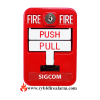

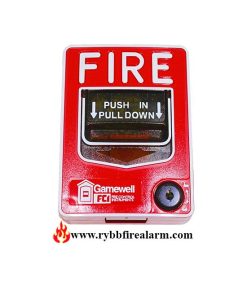
Edwards 279B-1110 Double-Action Pull Station
$38.00
The Edwards 279B-1110 is a red double-action fire alarm pull station with a single-pole alarm contact, 6-inch wire leads, and tool-operated reset.
21 in stock

The Edwards 279B-1110 Double-Action Pull Station is a conventional, non-coded fire alarm initiating device in the Edwards 278B/279B Series. It uses a double-action operating mechanism and is designed for general-alarm applications. The 279B Series differs from the 278B Series primarily by using 6-inch (150 mm) wire leads instead of screw terminals for field connections.
The 279B-1110 specifically provides a single-pole, normally open alarm contact and requires a tool to reset the station after activation.
Product Functions
- Provides manual fire alarm initiation
- Uses double-action activation
- Provides a single-pole alarm contact
- Uses a normally open alarm circuit
- Provides 6-inch field wiring leads
- Uses tool-operated reset
- Latches after activation until reset
- Supports general-alarm operation
- Operates as a conventional non-addressable initiating device
- Supports optional series resistor kits for applicable smoke-detector circuits
- Can be surface or semi-flush installed with appropriate equipment
Double-Action Operation
The 279B-1110 belongs to Edwards’ double-action 279B Series.
Double-action operation requires an additional physical action before the alarm mechanism can be fully operated, helping reduce unintended activation compared with a basic single-action station.
Edwards identifies both the 278B and 279B families as double-action stations. The key difference is their field connection:
278B Series: Screw terminals
279B Series: 6-inch / 150 mm wire leads.
Single-Pole Alarm Contact
The 279B-1110 provides:
Contact Configuration: Single pole
Normal Circuit Condition: Open circuit
Alarm Type: General alarm.
When the station is activated, the alarm contact changes state and signals the connected conventional initiating circuit.
Tool-Operated Reset
The 279B-1110 uses a:
Reset Method: Tool operated.
After the station has been activated, authorized personnel must access the mechanism with the appropriate reset tool and return the station to its normal position.
This distinguishes the 279B-1110 from related Edwards models that use a keyed reset mechanism.
6-Inch Wire Leads
The 279B Series uses factory-provided:
Field Connections: 6-inch / 150 mm wire leads.
This is an important distinction when comparing the 279B-1110 with the closely related 278B-1110, which performs a similar function but uses screw-terminal connections.
279B-1110 vs. 278B-1110
279B-1110: 6-inch wire leads
278B-1110: Screw terminals
Both are double-action, single-pole, open-circuit, tool-reset stations.
Conventional Fire Alarm Operation
The 279B-1110 is a conventional fire alarm initiating device.
It does not contain an addressable communication interface. Instead, operation changes the condition of its alarm contact, which is monitored by the connected fire alarm initiating circuit.
If the station needs to be incorporated into an addressable fire alarm system, an appropriate compatible addressable monitor/interface module may be required depending on the system design.
Contact Electrical Information
Manufacturer documentation specifies:
30 VAC: 3.0 A
28 VDC: 1.0 A.
These ratings represent the published contact limits. Actual fire alarm circuit loading must also comply with the requirements of the connected fire alarm control equipment.
Optional Series Resistor
When the 279B-1110 is installed on certain circuits that also contain smoke detectors, Edwards allows a series resistor to be added to the alarm initiating contact.
This arrangement can prevent operation of the pull station from extinguishing alarm LEDs on smoke detectors that have already operated.
For the single-pole 279B-1110, Edwards identifies the compatible:
276-R Series Resistor Kit.
The catalog documentation identifies the applicable resistor as approximately:
560 Ω, ±5%, 2 W.
Installation Information
For semi-flush installation, Edwards specifies a standard North American:
4-inch square electrical box
with a single-gang plaster cover and an overall minimum depth of:
2-1/4 inches / 57 mm.
For surface installations, Edwards specifies:
276B-RSB — Red Surface Back Box.
Typical installation involves connecting the 6-inch leads to the supervised initiating circuit, securing the station, restoring the system, activating the double-action mechanism, confirming alarm reporting, and then using the appropriate tool to reset the station.
| Weight | 2 lbs |
|---|---|
| Dimensions | 6 × 6 × 6 in |
Vendor Information
- Store Name: Miami
- Vendor: Miami
-
Address:
7713 NW 46 Street
Doral, FL 33166 - No ratings found yet!
Related products
Pull Stations
Pull Stations
Pull Stations

Pull Stations

Pull Stations

Pull Stations
Pull Stations

Pull Stations