
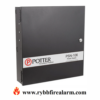

Fire-lite HPFF8CME (NEW)
$903.96
HPFF8CME (NEW)
3 in stock

New without metal box/cabinet.
The Honeywell HPFF8(E) and HPFF8CM(E) are Notification Appliance Circuit (NAC) Expander Power Supplies designed to extend the power capabilities of existing NACs and provide power for auxiliary devices. The HPFF8 and HPFF8CM connects to any 12 or 24V Fire Alarm Control Panel (FACP) or operates stand-alone. They provide regulated and filtered 24VDC power to four NAC’s and an auxiliary output. The NAC outputs are rated at 3.0 amps each and the auxiliary output is rated at 2.0 amps (this output is continuously supplied, even in alarm, and therefore must be taken into account for power supply loading and battery size calculations). The combined output cannot exceed 8.0 amps. The HPFF8 and HPFF8CM provide independent output circuit supervision so in the event of a NAC fault they can notify the attached FACP. In addition they have a trouble memory feature that displays past troubles (by NAC) for rapid diagnostics. Synchronization is built in for five appliance brands. The HPFF8 and HPFF8CM have two fully independent supervised initiating circuits that can be used for synchronized strobes and coded horns. Their NAC outputs may be configured as any of the following:
• four Class B (Style Y)
• two Class A (Style Z)
• two Class B and one Class A
• four Class A with the optional HPP31076 Class A adapter
These power supplies contain an internal Battery charger capable of charging up to 26.0 amp-hour (AH) batteries. The HPFF8 is mounted in a lockable wall cabinet that can accommodate up to two 18AH batteries. The HPFF8CM is designed to mount in Honeywell’s large equipment enclosure (EQBB-D4; order separately). Up to four HPFF8CM supplies can be mounted in a D-sized EQ cabinet. Each HPFF8CM can accommodate two 12AH batteries. One of the most challenging aspects of a retrofit application is locating the existing End-of-Line (EOL) resistor. In these applications that have EOL values other than the 3.9k normally used with the HPFF8, a single resistor matching the existing EOL can be used as a reference for all the outputs. This feature speeds installation and system checkout because the actual EOL does not need to be located and changed in the circuit. The reference resistor must be within the range of 1.9k to 25k.
| Weight | 15 lbs |
|---|---|
| Dimensions | 24 × 11 × 7 in |
Vendor Information
- Store Name: Jacksonville
- Vendor: Jacksonville
-
Address:
1981 Wells Rd
Orange Park, FL 32073 - No ratings found yet!
Related products


Fire Alarm Panel
Annunciator
Loop Expander
Fire Alarm Panel
Fire Alarm Panel
Fire Alarm Panel
Fire Alarm Panel